

Growth in the shadow of (geo)politics
Swiss Re Institute’s Sigma Report projects that over 2025-26 life insurance premiums are set to grow by 3%, more than double that of the past 10 years.
The global economy is poised for further solid expansion. Swiss Re forecasts global real GDP growth at 2.8% in 2025 and 2.7% in 2026, roughly in line with 2024. However, the distribution of risks is tilted to the downside, driven by geopolitical risk, the potential for disruptive policy changes, and financial market vulnerabilities. Growing divergence between regions will likely be accentuated by the policy direction of the next US government.
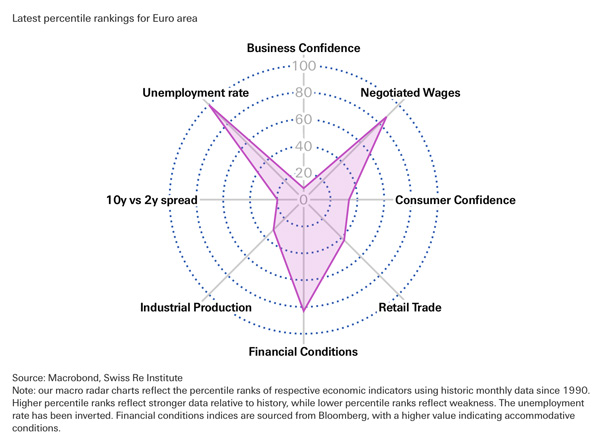
The proposals from President-elect Trump’s campaign have mixed implications for the US economy that will ultimately depend on their extent and sequencing, but Swiss Re anticipates slower disinflation and a shallower interest rate easing cycle now. They maintain their view that the US will continue its economic trend of outperformance, even if momentum will slow sequentially. This will contrast increasingly with the euro area and China, which face headwinds from trade tensions and structural challenges.
Table 1: Swiss Re Institute key forecasts
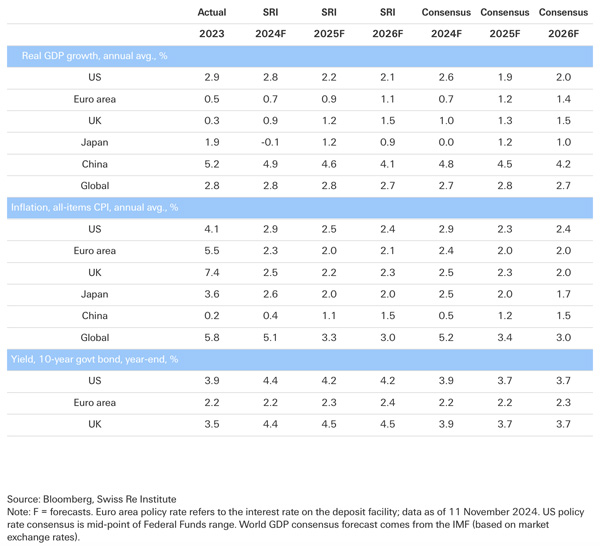
Swiss Re forecasts global CPI inflation to decline slowly to an average 3.3% in 2025 and 3.0% in 2026, from 5.1% in 2024. In response, a cautious US Federal Reserve will likely proceed with only three interest rate cuts in 2025, while central banks in the euro area and China ease policy faster as economic growth concerns dominate. However, fiscal risks may add upside pressure to long-dated bond yields in the West. Long term, their “five D” structural themes of deglobalization, decarbonization, demographics, digitalization and debt will shape the outlook.
Figure 1: Macroeconomic trends for the US economy
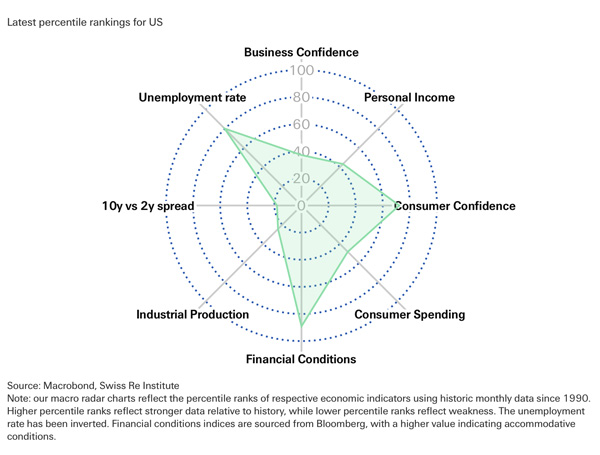
Figure 2: Macroeconomic trends for the euro area economy
Swiss Re sees risks of an adverse alternative economic scenario emerging. An event such as an escalation in geopolitical risk and tension, for example a disruptive trade war, or in financial market risks, such as a sudden and sharp rise in US Treasury risk premia, could bring us into one of two adverse scenarios they monitor, of (i) “renewed supply shocks” or (ii) a “global recession”.
A “renewed supply shock” scenario envisages a stagflationary shock of inflation acceleration and weak economic growth. This would stress non-life underwriting performance via low real premium growth and high claims severity. Asset portfolios would face mark-to-market losses. A “global recession” would see a broad fall in insurance demand and weak profitability of exposed lines. Wider credit spreads, lower interest rates and falling asset prices would depress investment results. They also monitor an upside “productivity revival” scenario, of tech-related investment benefits, but they view the likelihood as lower than the two downside scenarios together.
The global primary insurance market is to see above-trend growth in the next two years as the non-life hard market reaches an inflection point and life insurance sales ease from recent highs. They forecast 2.6% total global real premium growth on average in 2025 and 2026, lower than 2024 (4.6%), but higher than the past five years (2019‒2023 average: 1.6%). Steady global economic growth, resilient labour markets, rising real incomes as inflation moderates, and still elevated long-term interest rates will support demand.
Figure 3: Global total insurance industry premium real growth rates and forecasts (2024 values in brackets)

The primary non-life insurance industry is improving its profitability and economic sustainability. Underwriting results benefited from easing inflation and higher premium rates this year and Swiss Re expects them to stay strong in 2025 and 2026. Coupled with improving investment results, this should support profitability.
Figure 4: P&C insurance profitability, 2021‒2026F, % of net premiums earned, ROE and cost of capital, in % of capital
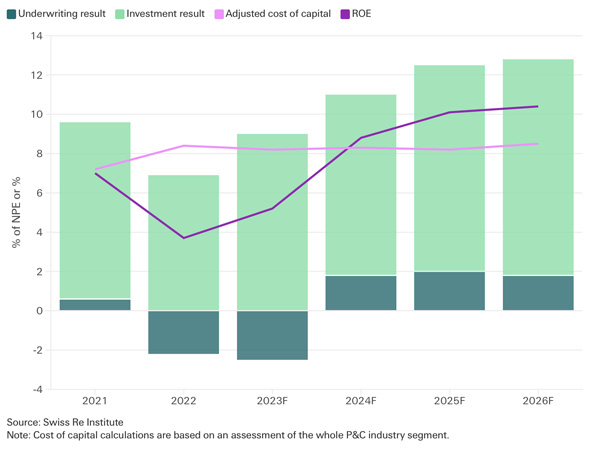
Swiss Re expects decade-high 4.3% global non-life premium growth this year following the repricing of risk in response to elevated claims. Premium rates are now moderating and they forecast softer global premium growth of 2.3% annually in real terms over 2025-26, below the 3.1% average of the last five years. The active US hurricane season is likely to take global natural catastrophe insured losses to well over USD 100 billion this year for a fifth consecutive year and may delay the onset of softer property insurance pricing.
The global life insurance industry is buoyant. Swiss Re projects growth of more than twice the historical average, at 3% in real terms over 2025 and 2026, after a decade-high 5% growth in 2024. Total global life insurance premiums should reach USD 4.8 trillion by 2035, up from USD 3.1 trillion in 2024, driven by higher interest rates. US individual annuity sales should reach a new record of over USD 400 billion this year.
Figure 5: Evolution of life insurance saving and risk premiums in volume (USD bn), left axis, and real growth (%), right axis
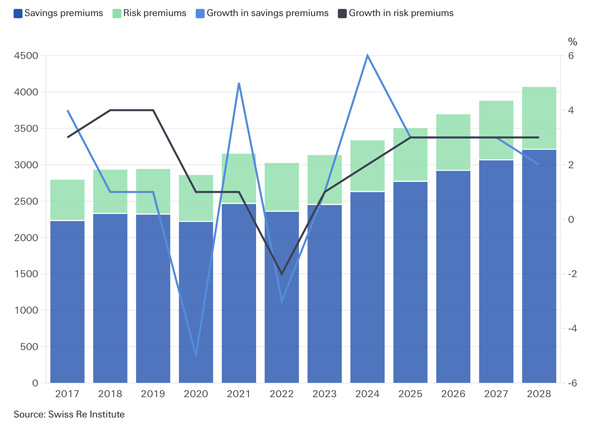
As monetary policy loosens, Swiss Re expects fixed rate annuity sales growth to slow and the focus to shift to indexed annuities. Pension de-risking offers another long-term tailwind for the life insurance industry, with potentially over USD 300 billion of bulk annuity transfers in the UK and US in the next three years.
Demand for risk protection is less interest rate-driven and we expect steady growth. Primary life insurance has a positive profitability outlook in 2025 and 2026, due to still elevated fixed-income yields. Lapse risk is contained, with declining sensitivity to interest rates as central banks lower interest rates.


